How to Hire a Personal Injury Lawyer in Ottawa
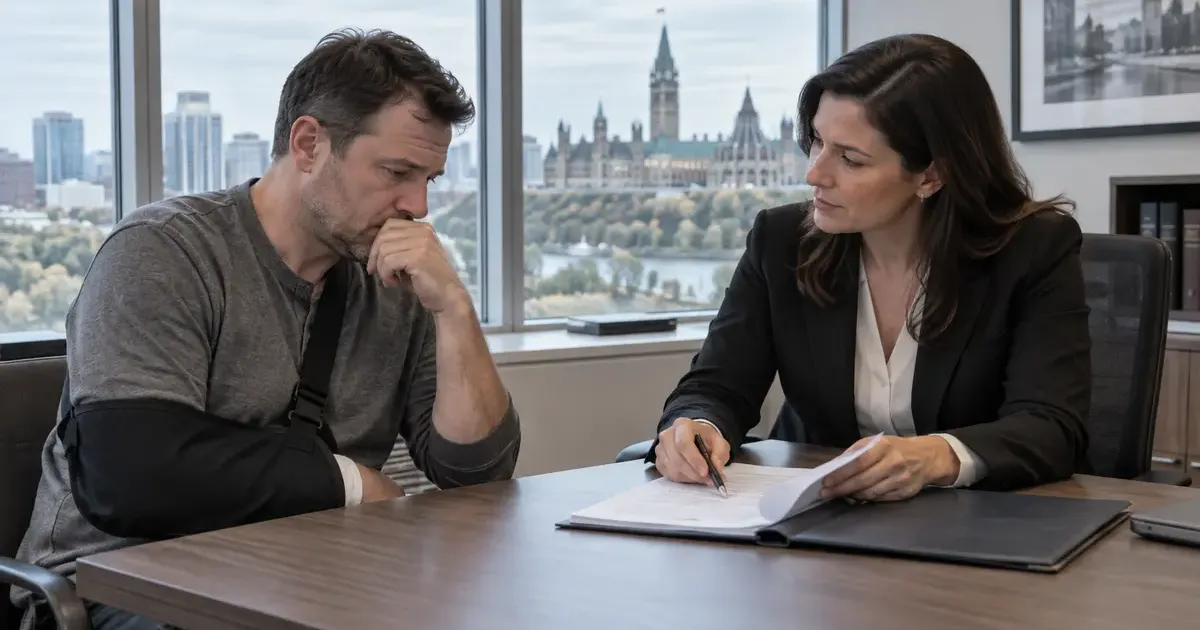
In Ontario, injury lawyers work on a no win, no fee basis, so the real question isn't whether you can afford one, it's which to pick. Fees, the two-claim system, and deadlines.
After a serious injury, the worry that stops people from calling a lawyer is money: you're hurt, maybe off work, and a lawyer sounds like a bill you can't take on. In Ontario that worry is mostly misplaced, because personal injury lawyers work on a "no win, no fee" basis. That flips the real question from whether you can afford a lawyer to which one you should hire. This guide covers how those fees actually work, the two separate claims a car accident sets off, and the short notice deadlines that catch injured people out.
You don't pay a lawyer up front
Ontario personal injury lawyers are allowed to work on contingency, which means you pay no hourly fee up front and the lawyer is paid a percentage of what you actually recover through a settlement or award. If there's no recovery, there's no fee. A few things are worth understanding before you sign. Case expenses, called disbursements, and HST are still payable, and they come off the recovery as a first charge, so ask how a firm handles them. Since July 2021 every contingency retainer has to use the Law Society of Ontario's standard-form agreement, and the firm must give you a plain-language consumer guide and tell you the general percentage it charges, which makes fees easier to compare from one firm to the next. You also keep the right to ask the Superior Court of Justice to assess the lawyer's final account if it looks off.
Because the fee structure is standardized, the smart move is to ask two plain questions of every firm you call: what percentage do you charge, and how are disbursements handled if we don't win.
One crash, two claims
A car accident in Ontario usually sets off two separate claims at once, and it's worth knowing which is which. The first is no-fault accident benefits, called SABS, paid by your own insurer regardless of who caused the crash. The second is a possible lawsuit in tort against the at-fault driver. They run in parallel under different rules and in different places: an accident-benefits dispute with your insurer goes to the Licence Appeal Tribunal, a province-wide tribunal rather than a courthouse, while a tort claim is filed in the Superior Court of Justice at the Ottawa Courthouse, 161 Elgin Street.
One recent change matters for every Ontario auto policy. Since July 1, 2026, all accident benefits except medical, rehabilitation and attendant care are optional, which takes in income replacement, caregiver and housekeeping benefits. An existing policy renews with the coverage it already had unless the policyholder agrees in writing to drop or change it, but the optional benefits now cover only the named insured, their spouse and dependants, and listed drivers, so some pedestrians, cyclists and passengers who used to qualify no longer do. So "which benefits did you actually buy" is a real early question, and a good injury lawyer won't just run the lawsuit, they'll work through both tracks with you.
The short deadlines that can end a claim
Most people know there's a two-year deadline to start an injury lawsuit in Ontario, and there is. The traps are the much shorter notice deadlines that apply before that. If you're hurt in a fall caused by the poor repair of a municipal road or sidewalk, you generally have just 10 days to give the City of Ottawa written notice of the claim, with the date, time, and location. And for a slip and fall on snow or ice, Ontario added a 60-day written-notice rule in 2020. Given Ottawa winters, the snow-and-ice deadline is an easy one to miss, and missing it can end an otherwise strong claim. If you think you might have a case, the safe move is to get advice quickly rather than waiting.
How to choose an Ottawa injury lawyer
Legal Aid Ontario doesn't fund personal injury cases, so for almost everyone the route is a no-win-no-fee retainer with a private firm, which is exactly why the fee comparison above matters. Beyond the percentage, ask a firm about its experience with your kind of case, whether that's a car accident, a slip and fall, or a workplace or premises injury, and about handling both the accident-benefits and the tort side of a car crash. Ask who at the firm will actually run your file. You can browse the 77 personal-injury firms in our Ottawa directory as of October 2026 and shortlist a few.
Personal Injury firms in City of Ottawa

Allan Snelling LLP is a full-service law firm based in Kanata, serving the Ottawa and Kanata area. Its lawyers practice personal injury, business and employment law, wills and estates, and criminal and quasi-criminal …
 Personal Injury
 Business & Corporate Law
 Employment & Labour Law
 Wills, Estates & Trusts

Auger Hollingsworth Accident & Injury Lawyers is an Ottawa personal injury firm founded in 2004 by Richard Auger, who was soon joined by his wife and law partner Brenda Hollingsworth. It represents injured clients acr…
Personal Injury
Badre Law Professional Corporation is a personal injury law firm based in Ottawa, serving clients across Ottawa and Eastern Ontario including Arnprior, Brockville, Carleton Place, Eganville, Perth, Renfrew, and Smiths…
Personal Injury
Bell Baker LLP is a full-service law firm based in Ottawa, founded in 1957. The firm has about fifteen lawyers serving individuals, corporations, and institutions across the greater Eastern Ontario area, with practice…
Business & Corporate Law Real Estate LawWills, Estates & Trusts
 Administrative & Regulatory Law

Bergeron Clifford LLP is a personal injury law firm headquartered in Kingston, with branch offices in Ottawa and Pembroke and consultation offices in Carleton Place and Perth. Ted Bergeron and Chris Clifford founded t…
Personal Injury
Brooker Law Office Professional Corporation is a personal injury and employment law firm in Ottawa. It's run by Tom Brooker, who has practised civil litigation since being called to the Ontario Bar in 1988 and focuses…
Personal InjuryEmployment & Labour LawFrequently asked questions
Do I pay anything up front for a personal injury lawyer in Ottawa?
Usually not for the lawyer's fee. Ontario injury lawyers work on contingency, so they're paid a percentage of what you recover and nothing if you don't win. Disbursements, meaning case expenses, and HST are still payable and come out of the recovery, so ask each firm how it charges and how it treats disbursements if the case is unsuccessful.
What's the deadline to make an injury claim in Ottawa?
The basic deadline to start a lawsuit is two years, but shorter notice deadlines can apply first: about 10 days to notify the City in writing for a fall on a municipal road or sidewalk, and 60 days for a slip on snow or ice. Because these are easy to miss, it's wise to get legal advice soon after an injury.
Does legal aid cover personal injury?
No. Legal Aid Ontario funds areas like criminal, family, and refugee law, but it doesn't fund personal injury claims, because those are normally handled on a no-win-no-fee basis. For an injury claim, the practical route is a contingency retainer with a private firm.