Do Smaller Law Firms Have Better Google Ratings?

The bigger the firm, the lower its Google rating tends to be. Solo firms average 4.55 stars; firms with 100 or more lawyers average 3.94. What that does and doesn't tell you.
Most people assume a big, established firm is the safe pick. On Google, the pattern runs the other way. The more lawyers a firm has, the lower its average rating tends to be. We looked at the 7,166 firms in the LawOnline directory that have at least five Google reviews and also tell us how many lawyers work there, and the star rating slides down steadily as firms get bigger.
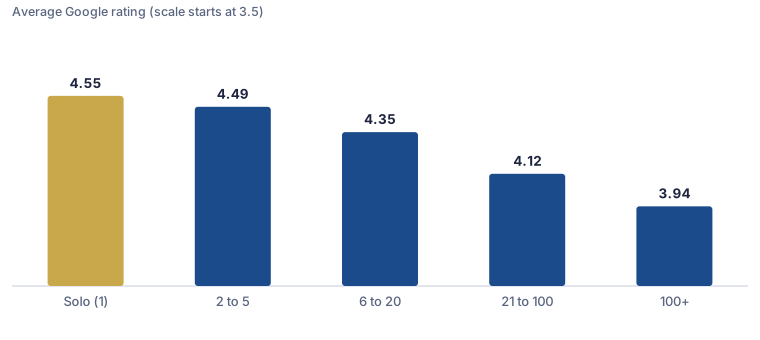
The bigger the firm, the lower the rating
Solo firms lead at an average of 4.55 stars, and 69 percent of them sit at 4.5 or higher, with almost a third holding an exact 5.0. Firms with two to five lawyers average 4.49, and the line keeps falling from there: 4.35 for firms of six to twenty, 4.12 for firms of twenty-one to a hundred, and 3.94 for the largest firms of a hundred lawyers or more. Among those biggest firms, only 16 percent manage a 4.5 or better. The overall average across the whole group is 4.49, so the giants sit well below the pack.
It's a clean, steady slope, not a blip. Every step up in size costs a firm a bit of its rating.
Why would a bigger firm score lower?
A few honest reasons, and none of them is "big firms have worse lawyers."
A large firm has one Google listing that pools the experience of thousands of clients across dozens of lawyers, so a handful of bad days always shows up in the score. A solo's rating reflects one person's client relationships, and a solo can more easily ask a happy client to leave a review. Bigger firms also do more of the work where somebody is guaranteed to walk away unhappy, like hard-fought litigation and insurance defence, and that ends up in the reviews. There's a related pattern we found earlier: as a firm collects more and more reviews, its average tends to drift toward the middle rather than stay pinned at the top.
Two caveats keep this honest. The largest band is small, just 19 firms with a hundred or more lawyers and enough reviews to count, so read that last bar as a direction, not a precise number. And big firms often publish only part of their roster on the public pages we read, so a few may be counted as smaller than they really are. If anything, that would understate the effect at the top, not invent it.
What it means when you're choosing a firm
A big firm's 4.0 isn't proof of weaker lawyers, and a solo's 5.0 isn't proof of stronger ones. The star number tracks a firm's size and scale at least as much as its quality, which is another reason it's a weak way to sort your shortlist. We made that case in why almost every law firm has a 4.5-star rating, and firm size is one more thing the number quietly folds in.
So use the rating as a rough floor, then read the written reviews for what actually matters: whether the firm returned calls, whether the bill matched the estimate, and how it handled a matter like yours. After that, match the firm to the job. Most everyday legal work is handled well by the solo and small firms that make up the bulk of the profession, while a genuinely large or multi-province matter can be worth a big firm's bench. When you're ready to compare, you can start your search here.
Frequently asked questions
Do bigger law firms have worse Google ratings?
On average they have lower ratings, not necessarily worse service. In our directory, solo firms average 4.55 stars while firms with 100 or more lawyers average 3.94, as of October 2026. A large firm's single listing pools thousands of clients across many lawyers, so a few bad experiences pull the average down in a way a solo's rarely does.
Why do solo and small firms have higher ratings?
A solo's rating reflects one lawyer's client relationships, and a small practice can more easily follow up with satisfied clients for a review. Larger firms handle far more matters, including adversarial work where one side always loses, so their public rating averages lower even when the work is strong.
Should I rule out a firm with a lower rating?
No. Treat the star number as a rough starting point, not a verdict. Read the written reviews for how the firm communicates, bills, and handles cases like yours, and weigh the firm's size and focus against what your matter actually needs.