Partner, Associate or Counsel: Who Will Handle Your File?

We mapped the titles of 40,115 lawyers in our directory. The median associate was called 4 years ago, the median partner 20. Here's who'll likely do your work.
When you hire a law firm you usually meet one lawyer, but that isn't always the person who drafts your documents or goes to court for you. The title on a lawyer's profile is one of the best clues you've got about who'll actually do the work and how much experience they bring. So we looked at the titles firms give their own lawyers, across 40,115 practising lawyers at the 11,011 firms published in the LawOnline directory as of October 2026.
Titles are whatever the firm's own website calls the person, and a lot of sites don't use a rank at all. About 57.6 percent of lawyers in our data carry a title that states one (founder or principal, partner, counsel, or associate). The rest are listed simply as "Lawyer," "Barrister & Solicitor," "Avocat" or similar, have a title that isn't a rank (like "Director"), or have no title at all, and we haven't guessed where they sit.
What do lawyer titles actually mean?
The titles follow a rough ladder, though every firm uses them a little differently. Here's how we grouped them and what each usually signals:
- Founder or principal. The lawyer whose practice it is. At a small firm this is the owner, and often the only lawyer.
- Partner. A senior lawyer who shares in running (and usually owning) the firm. Titles like managing partner, senior partner and shareholder count here. In Quebec, associé or associée means partner, not associate.
- Associate. A lawyer employed by the firm who isn't a partner, often earlier in their career. "Senior associate" marks someone further along. The French equivalent is collaborateur or collaboratrice.
- Counsel, senior counsel, of counsel. At most firms, an experienced lawyer who works with the firm but isn't a partner. "Associate counsel" belongs here too, despite the word: lawyers with that title in our data were called a median of 29 years ago. In Quebec you'll see avocat-conseil.
- Lawyer, Barrister & Solicitor, Avocat. The profession, not a rank. It tells you the person is licensed and nothing about seniority.
Quebec also has a second legal profession. A notaire is licensed by the Chambre des notaires du Québec rather than the Barreau, and there are 289 notaires among the lawyers in our data. Their work commonly includes real estate, wills and estates, so don't read the title as a junior one.
How experienced is a typical associate?
They're usually fairly new to practice. Among associates whose call year is published, the median was called to the bar 4 years ago, just over half (53.3 percent) were called less than five years ago, and 87.3 percent less than ten. Lawyers titled senior associate sit a step up, with a median of 8 years.
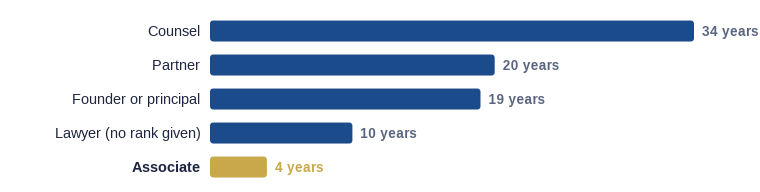
Partners are a different group altogether. The median partner was called 20 years ago, and only 9.9 percent haven't yet reached ten years at the bar. Founders and principals look much the same, at a median of 19 years.
Counsel turn out to be the most experienced lawyers on the roster, with a median of 34 years since call, and 75.1 percent have been at the bar for 20 years or more. That's consistent with firms using the title for senior lawyers who've stepped back from partnership or joined later in their careers, and it means "counsel" isn't the junior-sounding title some people assume.
A caution on these figures: call years aren't published for the whole roster. We have one for about 42 percent of partners and associates, 35 percent of counsel and 18 percent of founders and principals, so the medians describe the lawyers whose firms publish that detail. For more on call years across the profession, see how long Canada's lawyers have been at the bar.
Who's on the roster at small firms and large ones?
The bigger the firm, the more associates there'll be to share the work. At firms of two to five lawyers, partners and founders make up 63.5 percent of lawyers with a ranked title and associates 27.9 percent. From six lawyers up, the split settles at roughly half partners and founders, with associates making up between 36 and 40 percent.
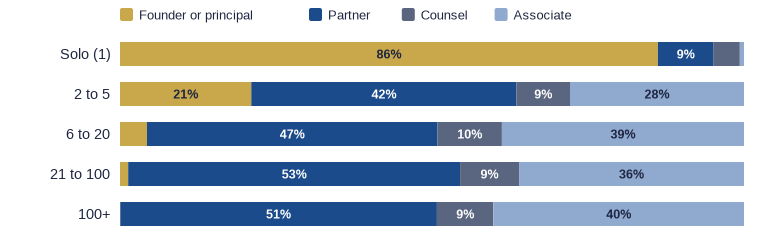
Put another way, a firm of two to five lawyers has about 44 associates for every 100 partners and founders, while firms of six to 20 lawyers and those with 100 or more have close to 80. So at a mid-sized or large firm, there's a real chance a partner takes the instructions and an associate does a good share of the drafting, research and routine court appearances.
Small firms also use rank titles less. Only 28.7 percent of lawyers at solo practices carry a ranked title, against 84.4 percent at firms of 100 or more lawyers. A solo lawyer doesn't need to tell you they're the principal, because there's nobody else.
At a small firm, is the lawyer you meet the one who does the work?
Very often, yes. Of the 10,626 published firms in our directory with at least one named lawyer, 5,780, or 54.4 percent, are a single lawyer, and 86.3 percent have five or fewer. At a solo practice the lawyer you meet is the practice, and at most small firms the team is small enough that you'll know everyone working on your matter. We looked at that in more depth in most Canadian law firms are solo practices.
That doesn't mean a solo lawyer does every task alone. Many work with law clerks, paralegals or assistants. In Ontario, Law Society Rule 6.1-1 says a lawyer must take complete professional responsibility for their practice and directly supervise any non-lawyer they assign work to, and a non-lawyer can handle assigned tasks only while the lawyer keeps a direct relationship with the client.
Is it a problem if an associate handles your file?
Not usually. Delegation can keep your costs down, and an associate with a few years of practice may be exactly right for a routine step that doesn't need a 20-year partner. Where it matters is when you're expecting one person and getting another, or paying for a level of experience that isn't the one doing the work.
The fix is just to ask early. When you first meet a firm, it's worth asking:
- Who'll be the main lawyer on my file, and how long have they been practising?
- Will anyone else work on it, such as an associate, clerk or paralegal, and on which parts?
- If you bill hourly, what's each person's rate?
- Who do I call with questions, and who'll be in court or at the meeting with me?
A firm that's organized will have a clear answer. When you're ready to compare firms, our find-a-lawyer search lets you filter by firm size, and each firm's profile lists its lawyers with the titles the firm uses.
Frequently asked questions
What is an associate lawyer?
An associate is a lawyer employed by a firm who isn't a partner. In our directory, the median associate whose call year is published was called to the bar 4 years ago, and 87.3 percent were called less than ten years ago, as of October 2026. Associates are fully licensed lawyers, usually working under a partner's direction.
What does "of counsel" mean at a law firm?
At most firms, counsel or of counsel describes an experienced lawyer who works with the firm without being a partner. In our directory, lawyers titled counsel have a median of 34 years since their call to the bar, and that's more than any other title.
Is a partner better than an associate?
Not automatically. A partner has more years of practice (a median of 20 in our directory, against 4 for associates), and their time may be billed at a higher rate. For many tasks an associate supervised by a partner is a sensible, cheaper choice. Ask who'll do which parts of your file.
What does "associé" mean on a Quebec lawyer's profile?
In Quebec, associé or associée means partner, so it isn't a junior title. The French title for an associate in the English sense is collaborateur or collaboratrice.