Do Lawyers Offer Free Consultations? What Firm Websites Say

We read what 11,011 law firm websites say about fees. About one in five offer a free first meeting, and nearly half in personal injury. Here's what to expect.
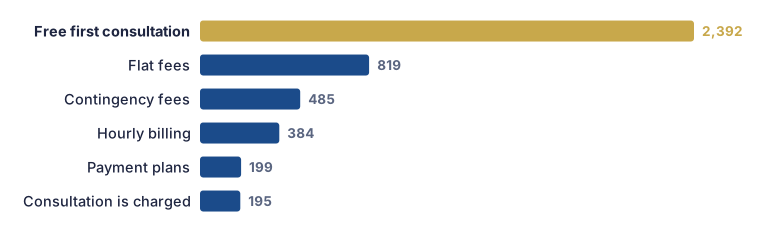
One of the first things people want to know before calling a lawyer is whether the first conversation will cost them anything. So we looked at what Canadian law firms actually say about it. Of the 11,011 firms published in the LawOnline directory as of October 2026, 2,392 say on their own website that the first consultation is free. That's about one in five, and the share swings a lot depending on the kind of law.
One caveat runs through everything below. We only count what a firm's website states. Most sites say nothing about fees at all (only 3,221 firms, or 29 percent, mention any fee fact we could record), and a firm that's silent isn't telling you it charges. Read every figure here as "at least this many firms say so," not as a measure of what firms actually do.
Is a first consultation with a lawyer usually free?
It's common, but it isn't the default, and you shouldn't assume it. Among the 2,587 firms whose websites say either way, 92.5 percent say the first meeting is free and 7.5 percent say it's charged. That's lopsided partly because a free meeting is worth advertising and a fee isn't.
Free usually means a short first conversation about whether the firm can help, not free legal work. If a site doesn't say, it's fine to ask when you call: is the first meeting free, how long is it, and what happens if you need advice on the spot?
Which kinds of law firms are most likely to offer a free consultation?
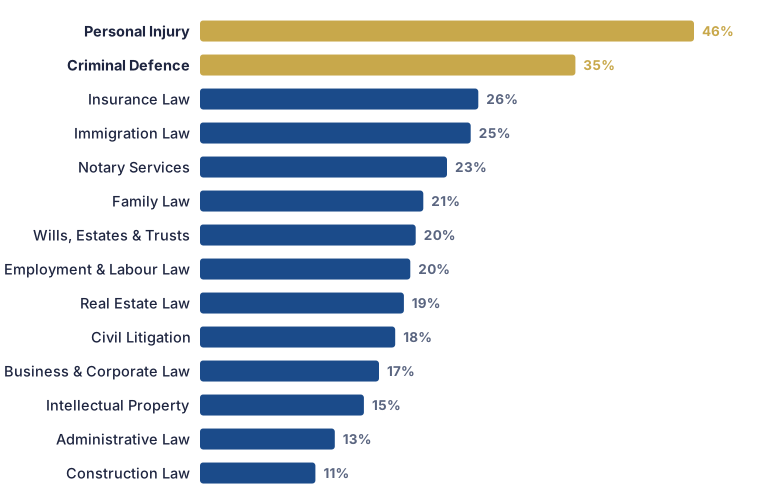
Personal injury firms lead by a wide margin. Of the 1,296 published firms that list personal injury, 45.8 percent say the first consultation is free, which is more than double the directory-wide rate. Criminal defence isn't far behind at 34.8 percent of 1,760 firms.
That fits how those firms get paid. An injury firm working on contingency only earns a fee if the case succeeds, so the first meeting is really the firm deciding whether to take the case on. Criminal defence is urgent and competitive, and someone who's just been charged often calls several lawyers in a day.
At the other end, construction law (10.7 percent) and administrative law (12.5 percent) firms are the least likely to advertise a free meeting. Those practices probably lean toward business and institutional clients who expect to pay from the first hour, so don't be surprised if a firm in one of those areas quotes a consultation fee.
Immigration is worth a separate mention. A quarter of immigration firms (25.1 percent) say the first meeting is free, but immigration also has the highest share saying it's charged, at 3.6 percent. Some immigration firms charge for an initial assessment of your options, so if you're shopping for an immigration lawyer, ask up front.
How do law firms say they charge?
Far fewer firms describe their billing than mention a free first meeting. Only 1,472 published firms, about 13 percent, name any fee model on their website. Flat fees are the one you'll see most, mentioned by 819 firms, followed by contingency fees (485), hourly billing (384) and payment plans (199).
Here's roughly what each one means for you:
- Flat fee. One set price for a defined piece of work, like a simple will, a real estate closing, or an uncontested divorce. You know the cost going in, but make sure you know exactly what's included.
- Hourly. You pay for the time spent. It's the usual model for litigation and anything whose length is hard to predict, so ask for an estimate and how often you'll be billed.
- Contingency. The lawyer takes a share of what you recover and nothing (or little) if you lose. Injury firms mention it far more often than anyone else.
- Payment plans. The fee is spread over time. Criminal defence firms mention them most often, at 5.9 percent of firms in that area, the highest of the 14 areas we measured.
The practice area shapes the model. Contingency shows up on 27.4 percent of personal injury firms' sites and on 7.5 percent of employment firms', where wrongful dismissal claims can work the same way. Flat fees peak at 10 percent of intellectual property and notary firms, and that's no surprise in two practices with plenty of well-defined, repeatable tasks.
Can a family or criminal lawyer work on contingency?
Not in Ontario. The Law Society of Ontario says lawyers can charge a contingency fee in any matter except family law, Criminal Code (Canada) matters, or other criminal or quasi-criminal matters. Rules differ by province, so it's worth checking with the law society where you live.
That's why the small number of family and criminal firms in our data that mention contingency deserve a closer look. Of the 81 family law firms whose sites mention contingency fees, 71 also list personal injury, civil litigation, employment or insurance work, so the contingency offer most likely belongs to that other side of the practice.
If you do sign a contingency agreement in Ontario, two Law Society rules work in your favour. A lawyer who markets on a contingency basis has to publish the general maximum percentage they charge on their website (or tell you when you first get in touch, if they don't have one), and they have to give you the Law Society's consumer guide, Contingency fees: What you need to know, before you sign. No maximum percentage is set by regulation, but the fee can't be more than what you actually receive from the award or settlement.
Do smaller firms offer free consultations more often?
Yes, though the gap doesn't really open up until the large end. Solo practices and firms of two to five lawyers are about equally likely to advertise a free first meeting (22.6 and 22.0 percent), but the rate drops to 17.5 percent at firms of six to 20 lawyers and 10.4 percent at firms of 21 or more.
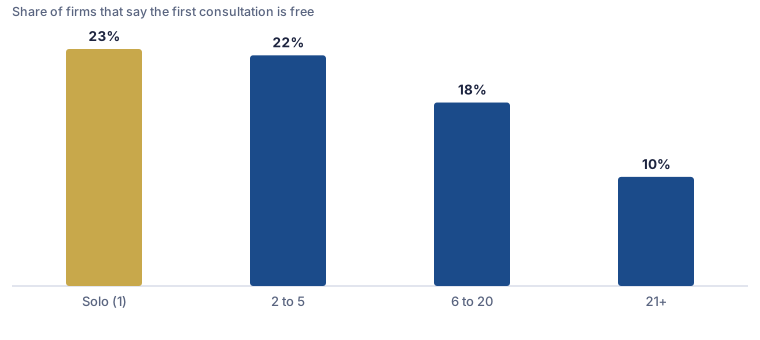
Bigger firms also say less about fees in general. Only 14.3 percent of firms with 21 or more lawyers mention any fee fact, against 30.5 percent of solo practices. A large firm's clients are more likely to be businesses that negotiate terms directly, so the website probably isn't where the pricing conversation happens. Since most Canadian firms are small, the firms you're most likely to call are also the ones most likely to tell you what the first meeting costs.
We haven't ranked provinces here. Quebec firms state far fewer fee facts in our data than firms elsewhere, and we're not confident that reflects how they bill rather than how completely we read French-language sites.
What should you ask before the first meeting?
The data tells you what's common, but only the firm can tell you what you'll pay. Before you book, it helps to ask:
- Is the first consultation free, and how long is it?
- Will I get any advice in that meeting, or is it an intake call?
- How do you bill for work like mine: flat fee, hourly, or contingency?
- If it's hourly, what's the rate of the lawyer who'll actually do the work, and can you give me an estimate?
- Do you offer payment plans or take legal aid certificates?
If a free first meeting matters to you, our find-a-lawyer search can filter to firms that say they offer one. If you'd like more on reading a firm's listing, see what Google ratings tell you about a law firm and whether your lawyer is a generalist or a specialist.
Frequently asked questions
Do most lawyers offer a free consultation in Canada?
About one in five firms in our directory say on their website that the first consultation is free, as of October 2026. Many more may offer one without advertising it, so it's worth asking. It's most common in personal injury (45.8 percent of firms) and criminal defence (34.8 percent).
How much does a lawyer consultation cost if it isn't free?
It depends on the lawyer, the practice area and the city, and few firms publish a figure, so there isn't a typical price we can give you. Of the firms whose websites say either way, 7.5 percent say the first meeting is charged. Ask for the price and the length of the meeting when you book.
What's the difference between a flat fee and a contingency fee?
A flat fee is a set price for a defined task, paid whatever the outcome. A contingency fee is a share of what you recover, so you usually pay little or nothing if the case fails. In Ontario, lawyers can't use contingency fees in family law or criminal matters.