Where Canada's Lawyers Went to Law School

Osgoode Hall leads, but the surprise is Windsor, which outranks older and more selective schools. Here is the law school behind Canada's working lawyers.
Ask someone to name Canada's top law school and you will usually hear Toronto or maybe McGill. The lawyers actually running firms tell a different story. We tallied the law school listed by 26,769 lawyers in the LawOnline directory, and the ranking that falls out does not match the prestige pecking order most people carry in their heads.
The two schools that produce the most lawyers
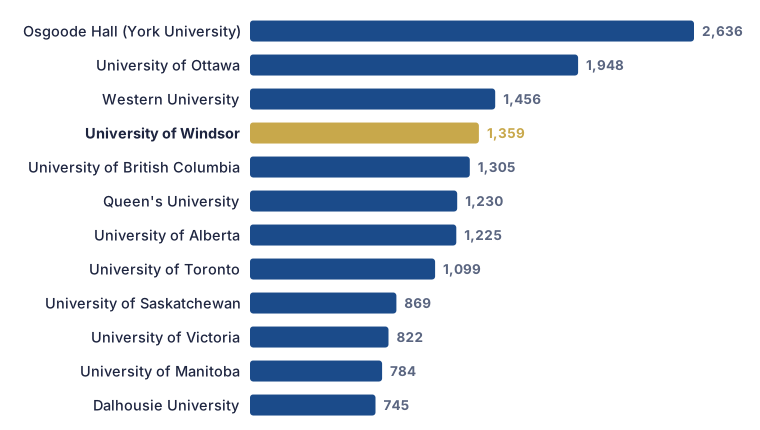
Osgoode Hall Law School at York University sits on top with 2,636 lawyers, well clear of the field. The University of Ottawa follows with 1,948. Both run large common-law programs. Between them they account for almost 4,600 of the working lawyers in our listings.
Add the third-place school, Western University, and the top three alone cover 6,040 lawyers, or about 23 percent of everyone who lists a school. The rest of the profession is spread across dozens of Canadian faculties and, as we will see, a long list of schools outside the country.
The Windsor surprise
The University of Windsor ranks fourth, with 1,359 lawyers, ahead of the University of British Columbia, Queen's, the University of Alberta, and the University of Toronto. Windsor is neither the oldest nor the largest law school in Canada, yet it puts more of its graduates into working practice in our directory than schools with far bigger reputations.
Toronto is the sharper puzzle. U of T law is routinely called the most selective program in the country, and it lands eighth here, behind Windsor and Alberta. One likely reason is where the graduates go. A directory like ours is built from firms with a public website and a client-facing practice, the kind of general and boutique firms that serve the public directly. Graduates who head into the largest corporate firms, into government, into the judiciary, or across the border to New York are less likely to show up as the named lawyer on a firm most people can hire. Prestige and volume are simply measuring different things.
Thousands trained outside Canada
The ranking isn't all Canadian. At least 3,000 lawyers in our directory earned a law degree abroad, at institutions ranging from Harvard, Columbia, and Cornell to the London School of Economics, King's College London, and universities across India and Nigeria. That's a floor, not a ceiling, since it counts only schools we could clearly identify as foreign. It's a reminder that a large share of Canada's working lawyers arrived by way of the National Committee on Accreditation route, which lets internationally trained lawyers qualify to practise here.
The freshest additions come from the other end of the age range. Canada's two newest law schools, Lakehead's Bora Laskin Faculty of Law and Toronto Metropolitan University's Lincoln Alexander School of Law, already have graduates in our listings, part of the younger tilt we found in call-to-the-bar dates.
Does your lawyer's law school matter?
For almost every ordinary legal need, no. Every lawyer on this list passed the same bar admission process for their province, and the school name on the wall says little about how good someone is at handling your divorce, your house closing, or your small business dispute. What predicts a good outcome is experience with your specific matter, clear communication, and a fee you understand before you sign.
So use the school as trivia, not as a filter. When you compare lawyers, ask how often they handle cases like yours, who will actually do the work, and how they charge. You can start your search here or browse firms by practice area.
Frequently asked questions
What is the best law school in Canada?
There is no single answer, and rankings measure different things. In terms of how many graduates are working as listed lawyers in our directory, Osgoode Hall leads, followed by the University of Ottawa and Western. That reflects program size and the kind of practice graduates enter, not a quality score, and it is based on our listings as of September 2026.
Should I choose a lawyer based on their law school?
No. Every practising lawyer met their province's bar admission standard regardless of where they studied. Fit for your specific matter, clear communication, and transparent fees matter far more than the school name. Treat the school as background, not a deciding factor.
Can a lawyer who studied abroad practise in Canada?
Yes. Internationally trained lawyers can qualify through the National Committee on Accreditation and then complete their province's licensing process. At least 3,000 lawyers in our directory hold a law degree from a school outside Canada.