After English and French, Punjabi Is the Language Canada's Lawyers Speak

Beyond English and French, Punjabi is the language most often offered by lawyers in our directory, ahead of Hindi, Spanish, and Mandarin. The legal profession mirrors the immigration map.
Canada has two official languages, but its lawyers advertise far more than two. When we set English and French aside and look at what else lawyers in the LawOnline directory offer their clients, one language sits on top of the rest: Punjabi.
The third language of Canadian law
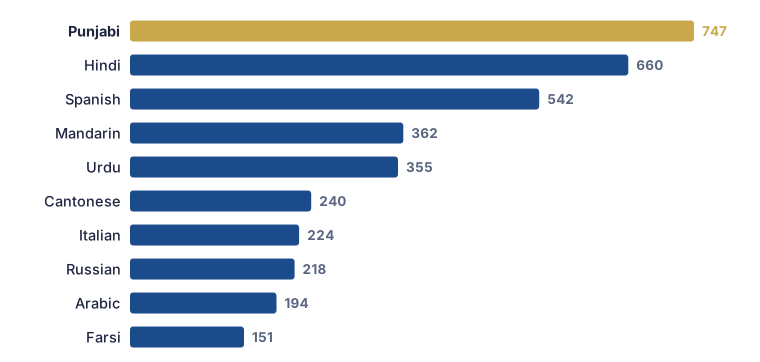
Set aside the two official languages and Punjabi leads with 747 lawyers, followed by Hindi at 660, Spanish at 542, Mandarin at 362, and Urdu at 355. Read the South Asian languages together, Punjabi, Hindi, Urdu, and Gujarati, and the group is the clear front-runner among the languages a client might need beyond English and French.
This isn't a coincidence. It tracks the country's recent immigration, where Punjabi, Hindi, Mandarin, and Arabic are among the most common mother tongues of newcomers. When a wave of immigration arrives, the demand for lawyers who can serve it follows, in immigration files first and then in real estate, business, and family matters. The legal profession ends up mirroring the map of who's moving to Canada.
Where these lawyers practise
The languages cluster where the communities do. Of the Punjabi-speaking lawyers in our directory, most practise in Ontario, British Columbia, and Alberta, the three provinces that have drawn the largest Punjabi-speaking populations. If you're looking for a lawyer in your own language, the odds are best in and around the big metro areas of those provinces.
A quick note on what these numbers are. They count lawyers who state a language on their firm's website, so they're a floor, not a census. Only about 28 percent of the lawyers in our directory list any language at all, which means the real counts are higher than what we can see. A firm that speaks Punjabi but never says so on its site doesn't show up here.
Why a shared language matters in legal work
This isn't about small talk. Legal work runs on precise communication, and a mistranslated fact can change an outcome. In an immigration application, a family agreement, or a real estate closing, being able to explain your situation in your first language, and to understand the advice you get back, reduces costly misunderstandings. It also builds the trust that makes people ask the awkward but important questions.
If language is a factor for you, say so early. Ask whether the lawyer, not just a receptionist or a paralegal, speaks the language, and whether documents can be explained in it. When you're ready to look, you can browse immigration lawyers or start your search here and filter for what you need.
Frequently asked questions
What is the most common language Canadian lawyers speak besides English and French?
In our directory, Punjabi, with 747 lawyers listing it, ahead of Hindi, Spanish, Mandarin, and Urdu. This counts lawyers who state a language on their firm's website as of September 2026, so it reflects advertised languages, not a full census of who speaks what.
Can I find a lawyer who speaks my language?
Often, yes, especially in larger cities. Many firms list the languages they work in. Because only some firms publish this, it helps to ask directly when you call, and to confirm the lawyer handling your file speaks the language, not only the front desk.
Does my lawyer speaking my language actually matter?
For anything detailed, it can matter a lot. Legal advice depends on precise understanding in both directions. Working in your first language lowers the risk of misunderstanding key facts and makes it easier to ask questions and follow the advice you're given.